Behind the Scenes at Our Rugby Club: How Teamwork and Dedication make it all happen one project at a time.
Updated: Aug 27
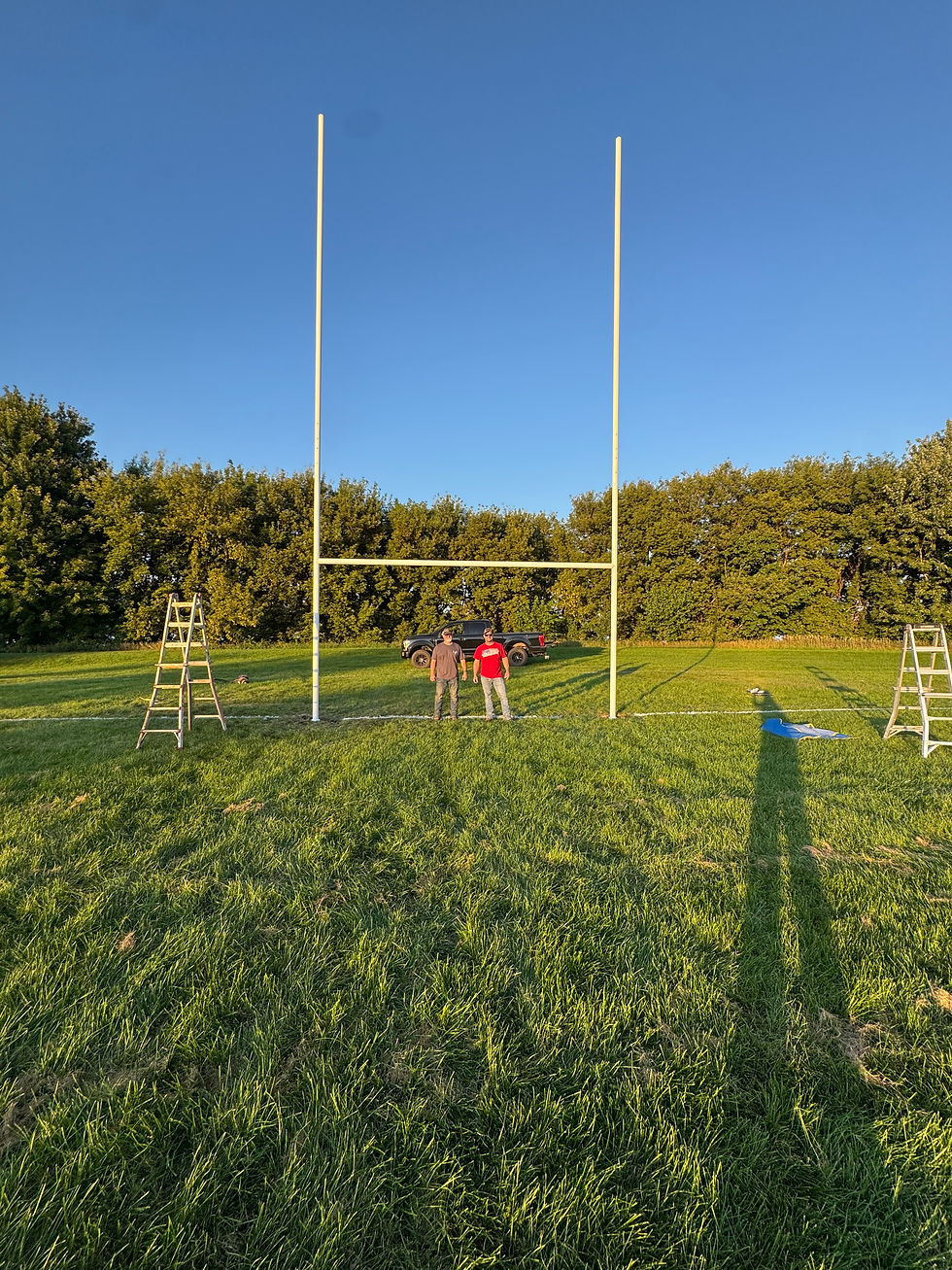

Most people see the finished field.
They see the lines, the pads, the posts standing tall, the players warming up, and the coaches calling everyone in. What they do not always see is the weeknight work, the phone calls after practice, the borrowed trailers, the sore backs, the measuring tape, the concrete dust, the parents who bring tools, and the coaches who quietly give more hours than anyone will ever count.
That is the part of rugby that matters just as much as match day.
Our recent goal post installation was one of those projects that reminded us what it takes to run a club. It was not just a facilities upgrade. It was a club effort from start to finish, led by care, relationships, and the belief that our players deserve a field that feels like home.
The project started long before the posts went into the ground
Installing new goal posts sounds simple until the work begins.
Before anyone picked up a shovel, there were decisions to make. What type of posts would fit the field? What materials would last? Who could source them? How would they be delivered? What tools would be needed? Who had the right trailer? Who could show up before or after practice? How would we do it safely and correctly?
That is where Coach Dustin stepped in.
Dustin’s connections made the first big difference. Rugby clubs do not run on endless budgets. They run on relationships. Dustin reached out to people he knew, asked the right questions, compared options, and helped us avoid wasting time or money on materials that would not hold up.
He worked through the ordering process piece by piece:
Confirming the correct height and style for the field
Checking material options for durability and safety
Coordinating with suppliers on availability
Sorting out what hardware and sleeves were needed
Making sure the order included the parts that are easy to forget
Tracking timing so installation could happen without delaying practices
That work rarely looks dramatic. No one cheers when a coach confirms measurements or follows up on an order. But without that work, the project stalls before it starts.
This is the true behind the scenes at our rugby club story. The visible moment came later. The foundation was built through planning, patience, and people picking up the phone.
The hours added up faster than anyone expected
Club work often happens in the margins of normal life. Coaches come after work. Players help after school. Parents stop by between errands, meals, and family schedules. What begins as “a few hours” quickly becomes an entire shared effort.
For this project, the hours told the real story.
Between Ron, Dustin, Dustin's dad, Jim B, Griffin, Brian (+ProTrucking painting, and LouRich ordering) and my time spent worrying about it we are talking well over 120 hours of work into this project.
That total does not include every text message, every reminder, every “I can swing by for a bit,” or every late-night check-in about whether we had what we needed.
It also does not include the mental load. Someone has to remember which bolts go where. Someone has to double-check that the sleeves are straight. Someone has to make sure the field stays usable, the players stay safe, and the project does not create a bigger problem than the one it solves.
That is coaching, too.
It is not only drills, selections, and halftime talks. It is looking at a field and thinking, “How do we make this better for the players?”
Moving the posts was a project of its own
The goal posts did not magically arrive at the field ready to stand.
Once the materials were ordered, the next challenge was logistics. The post sections were long, awkward, and not something you casually toss into the back of a car. They had to be moved safely, tied down correctly, and handled by enough people to keep anyone from getting hurt.
The transport plan came together the way many grassroots sports projects do. One person had access to a trailer. Another had straps. Someone else had the right socket set. Big projects do not happen because one person does everything. They happen because many people each take responsibility for one part.
That lesson carries over to the field. A try rarely belongs to one player. It comes from the pass before the pass, the support line, the cleanout, the tackle that gave the team possession, and the player who trusted the person next to them.
The same was true here.
Preparing the field took patience and muscle
The hardest part was not looking at the posts.
The hardest part was putting them in the ground the right way.
The field had to be measured carefully. The placement had to be checked more than once. Holes had to be dug to the right depth. Sleeves had to sit correctly. Posts had to stand straight and stay straight.
That meant time on hands and knees. It meant dirt, sweat, and sore shoulders. It meant stopping to check the level again even when everyone (mainly me) wanted to rush ahead. It meant making sure the work would last longer than the excitement of installation day.
There is a quiet pressure in that kind of job. If the posts are crooked, everyone sees it. If the sleeves are off, the problem does not hide. If the concrete sets wrong, fixing it becomes twice as hard.
So the group slowed down where it mattered.
And finally, two posts standing where there had been empty space.
Every strong club has a circle around it.
The players and coaches are at the center, but the club survives because of the people who stand just outside the touchline. Parents who drive. Families who stay late. Volunteers who lend tools. People who ask, “What do you need?” and mean it.
This project reminded us how important those relationships are.
A parent with a trailer can save the club from renting one. A parent with construction experience can prevent a costly mistake. A family that drops off food can keep volunteers going for another hour. Someone who cannot lift a post might still make calls, bring supplies, or watch younger siblings so others can work.
Those contributions are easy to miss if we only focus on the final result.
They are not small.
They are the difference between a club that is constantly stretched thin and a club that can keep building. They create trust. They make coaches feel supported. They show players that their sport matters to more people than they realize.
Running a rugby club depends on that trust. Coaches need parents to communicate, encourage commitment, and understand the work behind the schedule. Parents need coaches to care for their players, set standards, and keep the environment safe. Players need to see adults model service, not just talk about it.
The goal posts became a physical symbol of that relationship. They stand because people showed up.
Coaching asks for more than most people see
A project like this also brings up a harder truth.
Coaching and club management can be deeply rewarding, but they are also emotionally and physically demanding.
The physical side is obvious on days like installation day. Lifting, digging, hauling, setting, cleaning, and standing for hours takes a toll. Coaches do that work, then still show up to run training. They still plan sessions. They still answer messages. They still think about the player who needs encouragement, the player who needs accountability, and the team that needs direction.
The emotional side is quieter.
Coaches carry the wins and losses, but they also carry the details. They think about safety. They worry about numbers. They wonder if families feel connected. They try to build a culture where players want to work hard and come back. They make decisions that not everyone sees, and sometimes not everyone understands.
There are moments of real fatigue. A coach can love the club and still feel worn down. A volunteer can be proud of the project and still be tired. Dedication does not mean the work is light. It means people keep choosing it because the players are worth it.
That is why appreciation matters.
A thank-you in the parking lot matters. A parent offering to help before being asked matters. A player grabbing equipment without being reminded matters. These small actions tell coaches they are not carrying the club alone.
The finished posts belong to everyone
When the new posts finally went up, there was pride in the moment. Not loud pride. The quieter kind.
The kind that comes from looking at something and knowing exactly what it took.
Coach Dustin’s connections helped get the right materials moving. Coaches gave hours of planning and labor. Players learned what it means to serve the club beyond practice. Parents and community members made the hard parts possible. Everyone added a piece.
Now, when players line up a conversion or run drills under those posts, they are using something built by their own community.
That matters.
Rugby teaches support, effort, and trust. This project did the same. It showed that a club is not only built during matches. It is built on work nights, in pickup trucks, through group messages, beside open toolboxes, and in the moments when tired people stay a little longer because the job is not finished yet.
The posts are up now (well 75% - they'll be done by Saturday!)
The field looks better.
But the real win is the reminder that we can build something lasting when we build it together.


Comments